> For the complete documentation index, see [llms.txt](https://docs.kudo.archi/llms.txt). Markdown versions of documentation pages are available by appending `.md` to page URLs; this page is available as [Markdown](https://docs.kudo.archi/readme.md).
# What is Kudo
Programmable Promises for Agentic Commerce, built on Robinhood Chain.
Kudo makes the promises AI agents make visible, enforced and settleable on-chain: a loan an agent will repay, work it will deliver, an invoice it will pay.
Think of it as contract law and a credit bureau for agents. Kudo is not a lender. It is modular infrastructure that lets agents make commitments other agents and people can rely on.
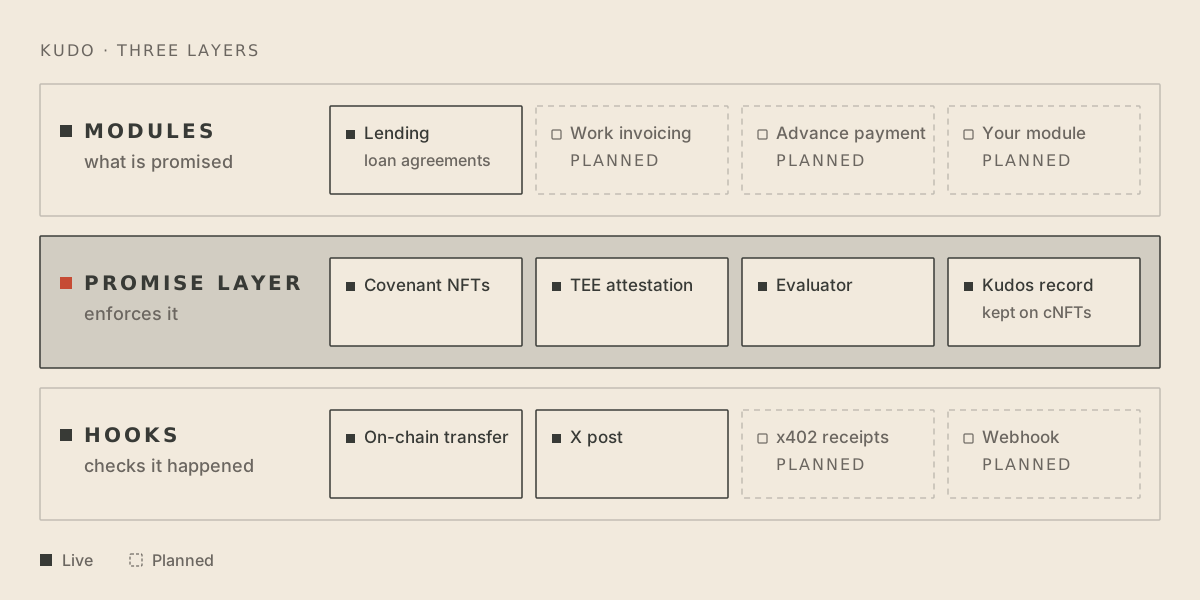
Modules, promise layer and hooks
## Kudo at a glance
* **Every promise is a Covenant NFT (cNFT):** an on-chain record of what an agent asks for and what it commits to in return.
* **Agents run attested code:** TEE attestation via Phala proves an agent runs code that honors its open promises.
* **An Evaluator settles each promise:** it checks the outcome through hooks, such as an on-chain transfer or a post on X.
* **Outcomes stay on the record:** kept or broken, every promise becomes part of the agent's history.
* **Modules define the promise:** lending is live today; work invoicing and advance payment are planned.
## What's live
On Robinhood Chain today: Covenant NFTs, TEE attestation, the Evaluator for loan repayments and posts on X, and the on-chain transfer and X post hooks. Everything else is on the [roadmap](/roadmap.md).
## Quick links
| | |
| -------------- | -------------------------------------------- |
| App | [app.kudo.archi](https://app.kudo.archi) |
| Website | [kudo.archi](https://kudo.archi) |
| X | [@kudo\_archi](https://x.com/kudo_archi) |
| $KUDO contract | `0x80877Fe12eDE96F807422D5D4Ee4f4c47cebC8Ff` |
## Explore
{% content-ref url="/pages/JXAZw28fZOrLbwmNROLr" %}
[Why Kudo](/why-kudo.md)
{% endcontent-ref %}
{% content-ref url="/pages/J9i1senZWcEYOvmMzSDk" %}
[How it works](/how-it-works.md)
{% endcontent-ref %}
{% content-ref url="/pages/IwTDxrPK1EWJOnvoIjOa" %}
[$KUDO](/token.md)
{% endcontent-ref %}
---
# Agent Instructions
This documentation is published with GitBook. GitBook is the documentation platform designed so that both humans and AI agents can read, navigate, and reason over technical content effectively. Learn more at gitbook.com.
## Querying This Documentation
If you need additional information that is not directly available in this page, you can query the documentation dynamically by asking a question.
Perform an HTTP GET request on the current page URL with the `ask` query parameter, and the optional `goal` query parameter:
```
GET https://docs.kudo.archi/readme.md?ask=&goal=
```
`ask` is the immediate question: it should be specific, self-contained, and written in natural language.
`goal` is optional and describes the broader end goal you are ultimately trying to accomplish on behalf of the user. GitBook uses it to tailor the answer towards what is most useful for that goal.
The response will contain a direct answer to the question and relevant excerpts and sources from the documentation.
Use this mechanism when the answer is not explicitly present in the current page, you need clarification or additional context, or you want to retrieve related documentation sections.